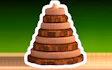

About Move the Tower
You'll move a stack of discs from one rod to another, but you can only shift one disc at a time and never place a bigger one on top of a smaller one. It sounds simple until the stack grows and every move starts to matter.
Read moreShow less
This is a slow burn kind of puzzle game, the kind where you plan three or four moves ahead before you even touch a disc. Each new level adds another disc to the tower, and that single extra piece can double how much thinking the level actually needs.
Progression in Move the Tower is refreshingly straightforward, each level simply adds one more disc to the starting rod, and that alone reshapes the whole puzzle. What worked for a three disc tower won't work for a six disc one, so you're constantly adjusting your strategy rather than repeating the same pattern. It's a great pick if you enjoy brain teasers that reward patience over reflexes. The presentation stays clean and minimal, with simple rods and discs that keep your focus on the puzzle instead of on flashy effects, and light sound cues that confirm each move without getting in the way.
If you like puzzles that make you think a few steps ahead, Move the Tower is worth a try. It's easy to jump into right away, and each level gives you a fresh reason to come back and beat your own best solution.
Quick summary
- Rebuild the tower on a new rod while following two strict rules.
- Use a third rod as temporary storage to free up the disc you actually need to move.
- Watch the puzzle get tougher with every level as more discs join the stack.
- Play risk free in sandbox mode when you just want to mess around with the discs.
- Drag and drop controls make it just as easy on a touchscreen as it is with a mouse.
- Figure out the shortest path to victory instead of just shuffling discs randomly.
Key features
- A classic logic puzzle rebuilt as a clean, modern browser game.
- Simple two rule system that's easy to learn but hard to master.
- Levels that scale up smoothly as the tower gets taller.
- Works equally well with a mouse or a touchscreen.
- A no pressure sandbox mode for free experimentation.
- Fast rounds that fit into a short break or a longer thinking session.
Tips & tricks
- Plan your next two or three moves before you drag a single disc.
- Use the empty rod as temporary storage instead of trying to solve it in one line of moves.
- Remember that the smallest disc usually needs to move more often than the others.
- Practice in sandbox mode first if a level's disc count feels intimidating.
- Try to picture the whole solution as a mirrored pattern, moving the tower back and forth between rods.





Comments